Your stress shows in your weeks. And it can ease.
30-second weekly check-in, daily activity pulse, 8-week trend — Mental Loadless turns your stress into actionable data.
Mental Loadless is not a health app. It is an organizer that gets the looping thoughts out of your head (appointments, groceries, chores) and shows you, week after week, when the load is building up. A 30-second check-in, an 8-week trend and an encrypted private space round it out.
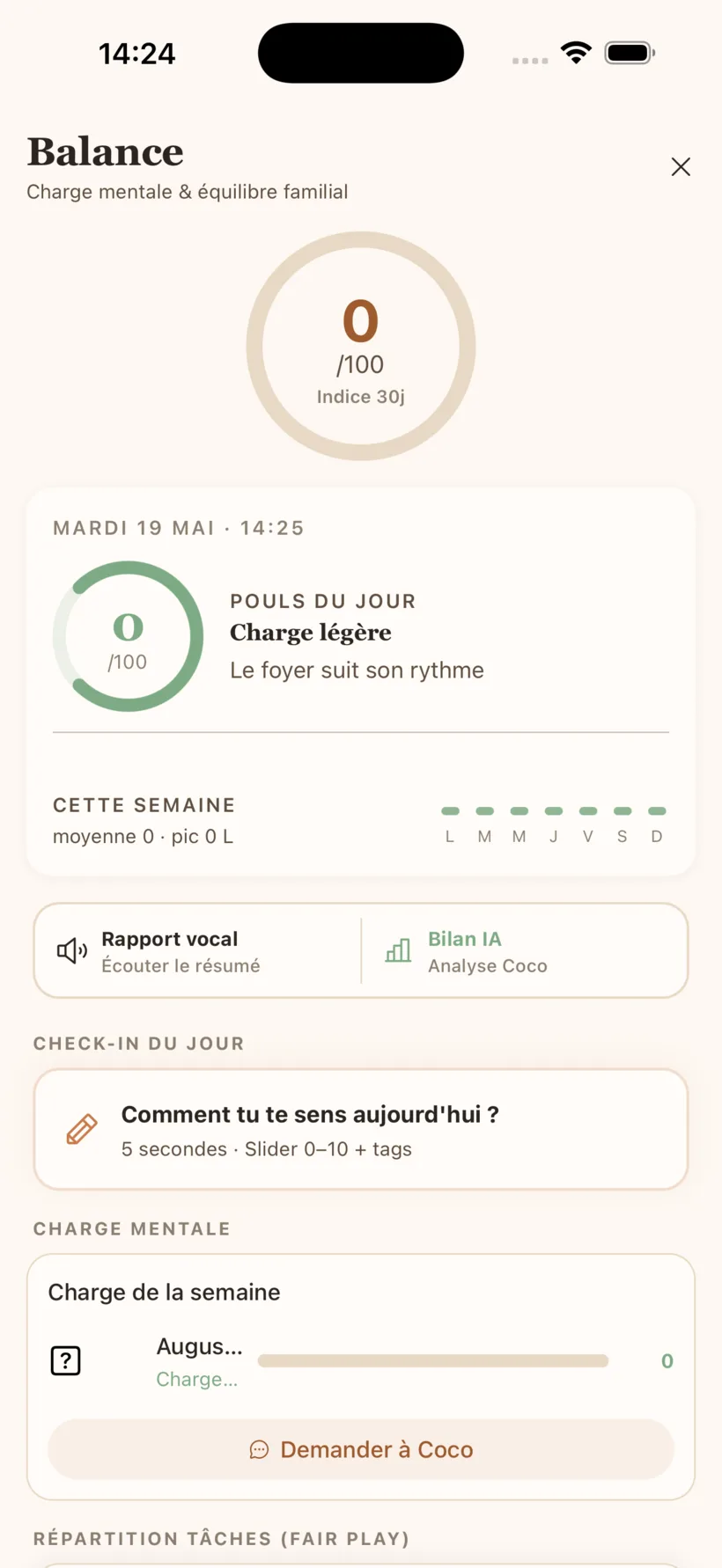
Your anti-stress toolkit
Daily pulse
A daily activity index: see how loaded each day really was, and spot patterns by end of week.
MLI & Fair Play
The MLI (Mental Load Index) measures each adult's share of the household load, methodology published in the app. As a family, Fair Play weights 29 tasks and Coco suggests a rebalancing.
8-week trend
A 30-second weekly check-in (rumination, energy, satisfaction): the curve shows when the load is setting in, before overload.
Me Time
Plan your untouchable personal moments. Blocked in the calendar, visible to everyone.
Private space
Mood journal, personal notes, private tasks. Protected by biometrics.
How is the mental load linked to everyday stress?
Everyday stress is not only about what you do. It comes from everything you have to keep in mind around it: the appointment to book, the form to send back, the fridge to fill. That is the mental load: anticipating, monitoring, remembering, even while you are sitting still.
Research connects the two. A 2023 review of 31 studies concludes that women perform the larger share of this mental labor and bear more of its effects, stress included. A 2014 US study found that mothers and fathers think about family matters equally often, but that those thoughts harm emotional well-being only in mothers.
The science behind the MLI explains how the app breaks this work down into phases.
What does the app track, and who sees it?
Four markers, each with its own visibility:
| Marker | Rhythm | What it shows | Who sees it |
|---|---|---|---|
| Weekly check-in | 30 seconds, 3 questions | what kept running through your head, your energy, your satisfaction | you; on the Family plan, your averages appear in the adults' monthly report |
| Trend | 8 weeks | how the load moves, and the heaviest day | the adults in the household |
| 30-day index | ongoing | the load coming from the calendar and tasks | the household |
| Well-being log | daily, a few seconds | mood, energy, sleep, a note | only you |
The three check-in questions: did household tasks keep running through your head this week? What was your energy level? Did the week's split suit you? Each one is answered from 1 to 5, and the monthly report (from the Solo plan up) compares these averages with the previous month.
Skipping a week triggers no counter and no nudge. The trend is there to help you see a busy stretch coming, not to judge you.
What stays private?
The private space is encrypted, locked by PIN and biometrics, and visible only to you. It holds what is nobody else's business: your daily well-being log, a journal, notes, private tasks and Me Time slots, which can repeat every week.
The weekly check-in follows a different rule: it feeds the household measurement. Anything you want to keep to yourself belongs in the private space, not in the check-in.
What can you do when the trend goes up?
- Find the heavy day. If Tuesday stands out week after week, it is Tuesday's calendar that needs a look.
- Move one thing. "Move Tuesday's appointment to Thursday": Coco moves the event without you opening the calendar.
- Hand over a whole area. In a couple, the app transfers an area, anticipation, reminders and checking included, to the other adult; for 21 days, your reminders for it are switched off.
- Declare a busy period. A crunch at work, a new baby: a "chosen imbalance" can be declared without any justification, and the app stops flagging the gap.
- Protect a slot. A recurring Me Time, booked before the week fills up.
For sharing the load as a couple, see the app for couples.
When is it time to talk to a professional?
Mental Loadless is not a health tool. It organizes and measures the household load; it says nothing about your health and replaces no professional. If tiredness sets in, if sleep no longer restores you, if everything starts to feel too heavy, talk to your doctor or a psychologist.
In France, Mon soutien psy gives direct access to up to 12 sessions a year with a partner psychologist, assessment session included, without a GP referral, at €50 a session with 60% reimbursed by national health insurance. To work out who to turn to, read which professional to see for the mental load.
Frequently asked questions
- Is Mental Loadless a mental health app?
- No. It is a family organizer that measures and shares the mental load. The MLI is not a diagnosis; if you are struggling, talk to a professional.
- How does the app reduce daily stress?
- By getting things out of your head: what is written, planned and shared no longer needs to be remembered. Coco handles the reminders.
- Can the rest of the family see the well-being space?
- No. The private well-being space is protected and shared with no one.
Take back control
Wellbeing tracking is free. Start today.